
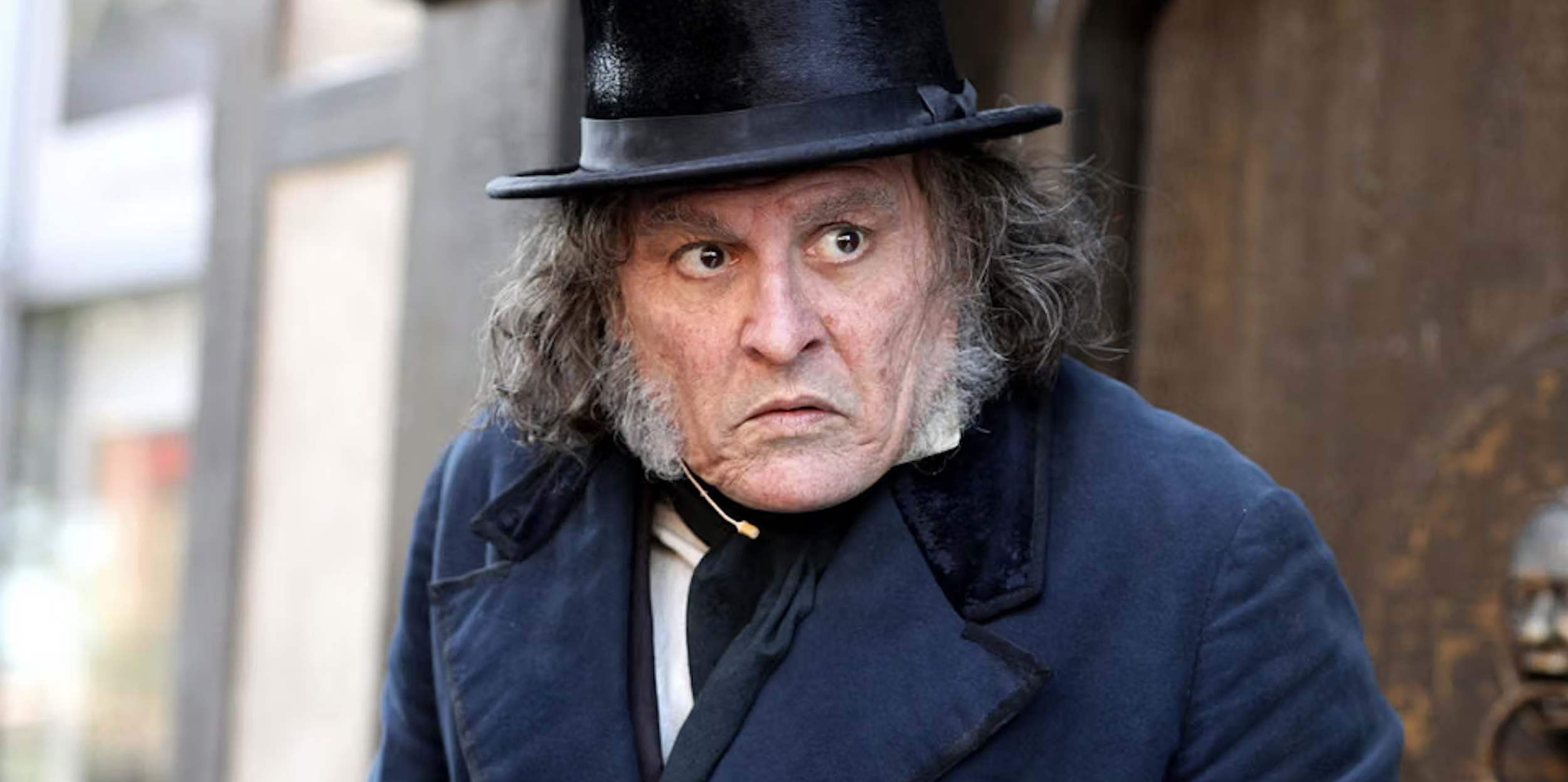
Johnny Depp in Ebenezer
The Turn of the Scrooge: West Wanes with Dusty Dickensian Revamp
By Nicholas Bell | Published on November 11, 2026
Only Dr. Seuss has been able to create an equally iconic Christmas-hating villain to rival the legacy of Charles Dickens’ Ebenezer Scrooge from A Christmas Carol, the redeemed loan shark whose miserly frugality is quelled by a spiritual reckoning with the greed he’s chosen to fill past traumas and unrealized dreams. There have been countless interpretations of this surly villain, who originally appeared in print in 1843, ironically selling out the first printing by Christmas Eve that year only days after initial publication. There’s a significant legacy of Scrooge’s irascible imprint on cinema, leaving some large shoes to fill in the wake of performances from Alastair Sim, George C. Scott, Michael Caine, Bill Murray, Patrick Stewart, and Cicely Tyson. But there’s an immediate novelty conjured in Ti West’s studio remount, Ebenezer, thanks to its simultaneous campaign to reinstate the fallen matinee-idol status of Johnny Depp as the crude, cantankerous lost soul who quite modestly exemplifies the adage that ‘hurt people hurt people.’ Unfortunately, the novelty remains superficial in this latest realization even as West stridently attempts to lean into the nightmarish elements defining the tale’s periphery.
It’s London, 1836, and successful financier Ebenezer Scrooge (Depp) and his longtime business partner Jacob Marley (Ian McKellen) seem resigned to their frugal miseries by fleecing their despairing clients through exorbitant interest rates, reveling in their shared hatred for Christmas. After degrading their woebegone clerk Bob Cratchit (Rupert Grint) by forcing him to return to work on Christmas Day, Mr. Marley suddenly dies while making some gin-spiked tea. Seven years pass, and on Christmas Eve, Ebenezer is visited by the ghost of Marley, who is weighed down in the afterlife by chains forged from his cruel actions while he was alive. Marley warns Ebenezer that his own significant chain awaits him unless he makes some changes, and foretells that three different spirits will pay him a visit that same night, showing him visions from his past, present, and future.
While Depp’s casting feels like an appropriate vessel for the performer’s preferred gonzo gesticulations, there’s an air of artificiality which pervades not only the approach but the entire production, evaporating the essence of catharsis and atonement essential to the narrative’s impact. While Depp is not delving into the Hunter S. Thompson territory underpinning many of his more exaggerated personifications, he never comes across as anything more than a crusty crony whose change of heart seems merely a drastic attempt to turn the beat around and save his vast fortune from falling into the hands of crooked entrepreneurs cut from the same cloth as him. In short, Depp’s Scrooge never transcends the trappings of the role and plays like an elitist who managed to stumble into a different way to cheat the karmic retribution coming his way, like he’s been dealt a way to benefit from existential insider trading.
Nathaniel Halpern’s script doesn’t help matters, gliding through the motions episodically. More interest is paid to delving into the inherently eerie personifications of the spirits of past and present (Andrea Riseborough and Tramell Tillman, respectively), themselves cursed souls who have been drafted for Scrooge duty. For all the garish details (such as the metaphorical entities trapped inside the belly of Tillman, meant to represent the ‘ignorance’ and ‘want’ which define the quicksand snare of surviving the ‘present’ without one’s basic needs being met), there’s something lacking in the effectiveness of these characterizations. Adding to this is a treacly score by Tyler Bates, which leaves one longing for the accompaniment of Danny Elfman’s gothic, melancholy notes to complement Depp’s gnashing. At one time, Tim Burton might have been better suited for straddling the dark whimsy of Dickens as opposed to West, who, despite being adept at horrific ideations, often stops short of truly succeeding with the malevolent force promised by his premises (see his bungling of the sleazy ’80s underworld of MaXXXine, the cap to his promising X Trilogy).
The glossy supporting (human) castmates are all one-dimensional stock characters, including Rupert Grint as the martyred Cratchit, Sam Claflin as Scrooge’s angelic nephew, and Daisy Ridley as the nephew’s opinionated but spineless wife. Only Ian McKellen seems to grasp at revelry as Scrooge’s partner-in-crime, but then, this also just feels like he’s being Ian McKellen.
Ultimately, Ebenezer never steps away from feeling like we’re on an artificial backlot, shoving us towards happy resolutions never properly earned. Previous iterations of Mr. Scrooge haven’t always ended with such a snug little bow (like Alfre Woodard’s neglected assistant to Bill Murray’s television executive in 1988’s Scrooged), but it’s unclear what, if anything, has been gleaned from the supernatural visitations beyond being more aware of intentionally enjoying one’s limited time as a mortal human being since you’re going to live tomorrow if you don’t die today.
★★½☆☆