
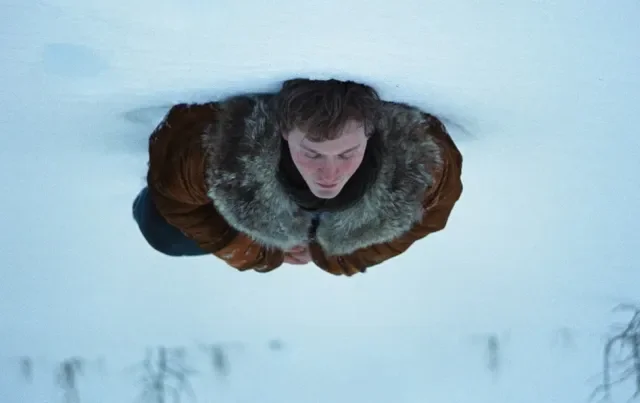
Fred Hechinger in A Long Winter
Winter of Our Discontent: Love May Keep Them Warm in Haigh’s Chilly Melodrama
By Nicholas Bell | Published on October 30, 2026
The poetic essence reflected in the enigmatic Rainer Werner Fassbinder title Love Is Colder Than Death (1969) could easily be applied to Andrew Haigh’s latest film, A Long Winter, based on a short story by Colm Tóibín (Brooklyn, 2015). In a faded mining town in the Colorado Rockies, a close-knit family of four finds itself on the verge of implosion just as the season’s first winter storm descends in 1951. Any semblance of happiness has long been a facade, and a sudden absence becomes an overwhelming presence dictating a murky path forward for those left behind. It’s also a subtly queer coming-of-age story as a young man finally begins to inadvertently contemplate his own desires in the wake of his mother’s disappearance. Her flight carves out a path for his own self-discovery, but anything resembling passion exists far outside the frame. It’s a tale of chilly, distilled dreams, where grief and resentment have hurtled one family’s possibilities into a dead end.
Louise (Caitriona Balfe) and Lester (Ebon Moss-Bacharach) have been married for twenty-five years, now meagerly living off selling rabbits in their isolated home fifteen miles from the nearest town. While Louise’s alcoholism is an open secret to all but her elder son, Mike (Fred Hechinger), who has recently returned after a year working on a farm in Idaho, the impending departure of his younger brother Tommy (Kit Connor) for military service seems to have heightened a sense of despair in the home. After Lester dumps Louise’s secret stash of wine, she suddenly disappears on foot one morning with only her winter coat and boots. But when a major snowstorm begins, it’s presumed she didn’t get far and most likely perished in the woods. Now, with Mike left alone with his grieving but bitter father, certain familial truths come to light. With both men seemingly unable to properly clean the house, they employ a local orphan, Jimmy (D’Pharaoh Woon-A-Tai), to tend to the “woman’s work” required at the house. But Mike finds himself drawn to Jimmy, whose biracial ancestry has solidified a pariah status he can’t seem to escape. The community, including Louise’s older brother (Martin Freeman), who lives on the other side of the mountain, patiently waits for the melting of the snow and the impending discovery of Louise’s corpse.
Haigh has a formidable knack for conjuring the essence of a specific time or place, even as his narratives sometimes elliptically resonate with one another. Echoes of the frozen lover rediscovered in 45 Years (2015) or the more straightforward approach afforded a lonely boy and his doomed horse in Lean on Pete (2017) come to mind here, as do the explicit nuances granted the tragic queer characters of All of Us Strangers (2023). But here, Haigh transports us to the doldrums of the early ’50s, a mangy main street showcasing a derelict theater with a marquee advertising the last film screened, the appropriately thematic The Snake Pit (1948) with Olivia de Havilland. As Mike, Fred Hechinger feels like a pupa, suddenly forced to contemplate a future not dictated by the stagnation of his parents, grieving a childhood that likely wasn't as happy as he remembered. Now he's left to wonder what was going through his mother's mind. Furtive glances towards a comely young local lawman and diffident fantasies feel realistic given his limited worldview, and Haigh brings a queer lens to the kind of narrative space that feels reminiscent of something from the likes of Laura Ingalls Wilder or Tobias Wolff’s agonized This Boy’s Life (1993).
Winter is itself a character, and she encroaches as the ultimate defining element, holding everything in stasis. André Turpin’s cinematography manufactures its own chill, magnifying a supreme sense of displacement and entrapment. The sexual yearnings, either paralyzed or long repressed, are somehow ever present, creating an enticing synergy, as if the film had its own seasonal affective disorder slowly escaping ancient sanctions, reminiscent of Mark Rydell’s underrated 1967 adaptation of D.H. Lawrence’s sensational The Fox (in which two lesbians find themselves agitated by Keir Dullea’s metaphorical interloper). But there’s an aching, melancholic trauma that darkly underlies the film, and composer Paul Haslinger deftly moderates these subterranean echoes in his score, particularly in the film’s first act, as we come to understand the anguished Louise, expertly realized by Caitriona Balfe. The setup feels like the working man’s version of Long Day’s Journey Into Night, an addict mother’s rage and unhappiness keeping her husband and two grown sons on a queasy precipice. It’s arguably simple in its overtness but elegantly orchestrated, with the spirit of a restless, trapped mother reformulating the masculine snares laid for her child.
As spring looms, the townspeople scan the sky for vultures, the scavenger birds that will likely lead them to Louise’s corpse. The metaphorical resonance of these maligned creatures parallels the queer experience of having to sift through the heteropatriarchal wreckage to find camaraderie, representation, and companionship. The film takes pains to relay how vultures lack a syrinx, the vocal organ that allows other birds to communicate. Like Louise and Mike, they are, metaphorically, voiceless creatures. Haigh’s created some lovely woods, dark and deep. But Mike’s got miles to go before he’ll sleep.
★★★★☆