
What Belongs to Others (Cudze rzeczy)| Review
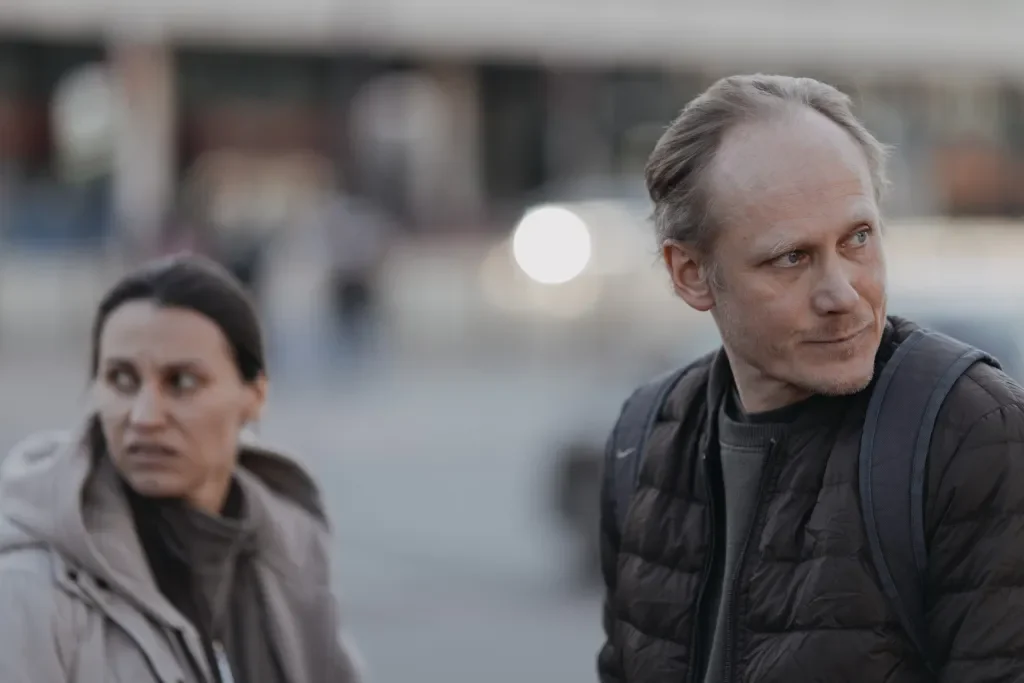
Monika Sabina Kwiatkowska and Robert Mania in What Belongs to Others
Venice Film Festival
Steal Big, Steal Little: Debowski Examines a Peculiar Providence
By Nicholas Bell | Published on September 12, 2026
One never knows how they’re affecting others, even in death, as it turns out, in Polish director Grzegorz Debowski’s sophomore feature What Belongs to Others, a poetic, layered title eventually suggesting those around us only own what we allow them to perceive. And that can be invented. A tenuous ‘make it till you break it’ scenario involving a petty hustler and con artist following the dictations of her violent boyfriend unspools in a narrative which could easily be modified into a pulpy neo-noir, where a stolen identity eventually allows for a transcendent reunion with humanity, and Debowski spins stringent miserabilism into hard-won poignancy through a woman who manages to turn a lie into a conduit for salvation.
Kasia (Monika Sabina Kwiatkowska) is several months behind on her rent in Warsaw, facing certain eviction unless she pays her irate, impatient landlord. She earns her living breaking into other people’s apartments, gaining entrance to buildings posing as a cleaning lady opposite her boyfriend, Darek (Robert Mania), a violent criminal hiding from police. Together, they pawn their stolen wares to a local pawnshop, but Darek insists on keeping all the money while demanding Kasia perform dramatic feats to keep the landlords appeased. As fate would have it, Darek is arrested for shoplifting, leading Kasia to fend for herself. Kicked out of her apartment, Kasia faces an additional layer of desperation, informing her traumatic reaction to finding a man who’s hanged himself in an apartment she intended to burglarize. When the police are called, she decides to pose as his close friend. His name is Piotr and she initially attempts to collect on his insurance policy. But she also becomes curious about the man, traveling to meet his dementia-suffering mother, his estranged sister, and bitter ex-wife. Eventually, her role as the pretend friend of Piotr offers a chance for his family to heal old wounds, while also allowing Kasia to find a way back to herself.
What Belongs to Others is the kind of film which depends upon the efforts of a leading performance to succeed, and Debowski channels a painstaking turn from Monika Sabina Kwiatkowska (who starred in his 2023 debut Next to Nothing). Dour doesn’t begin to describe her slog of an existence, caught between merciless landlords demanding back rent while her shitty boyfriend berates her during their cruel schemes, often involving the swindling of the elderly who aren’t able to properly articulate what or how certain items were stolen from their apartments. Kwiatkowska bears a striking resemblance to someone like Beatrice Dalle, but her Kasia is so beaten down by her existence, it would appear, that she’s doomed to the life of a street urchin whose luck is sure to run out eventually.
All this changes when Darek gets nabbed by the police, a fortuitous escape for Kasia. Shortly after, she’s jostled out of her apathetic daze when she discovers the body of Piotr, and this begins a slippery journey into redefining herself. The narrative belongs to the tradition of film noir, the kind featuring stolen identity rackets, such as No Man of Her Own (1950), with Barbara Stanwyck seizing a post-war opportunity for a better life. Eventually, some of those plots were reconfigured for comedy-of-errors induced romantic comedies, and there are a lot of comparative emotional elements between What Belongs to Others and something like While You Were Sleeping (1995), wherein a little white lie actually allows for a kind of healing and/or atonement otherwise unavailable to the parties involved, like jagged puzzle pieces smoothed for configuration, so all the colors of the portrait even out into harmonic tones.
The cruel, desensitized world occupied by Kasia would almost suggest she’s an alien to her own culture, her Polish brethren often treating her like a non-entity. This strangely recalls the Jeremy Irons character in Polish auteur Jerzy Skolimowski’s 1982 classic Moonlighting, a construction worker in London navigating the callousness of a country destined to reject him whilst significant political unrest back home forces him to remain unmoored. Debowski seems interested in examining hustlers on the periphery, evidenced by his earlier short films such as NDR (2016) or the struggles of a young Polish boy’s attempts to train as a boxer in 38,5 (2010). The extravagant detail of the corpse (also an element in Next to Nothing) is a sort of wake-up call for Kasia. What’s it like to walk around in a dead man’s shoes? Would anyone be curious to do the same for her? There’s an elegant ennui to Kasia, also reminiscent of the desperate titular character portrayed by Michelle Pfeiffer in Where Is Kyra? (2017).
A potent conversation with Piotr’s ex-wife might be the actual wake-up call for Kasia. “Everyone has a past. The important thing is to have a future,” she quips, explaining how Piotr’s depression was the downfall of their relationship. Kasia might be bearing this in mind upon her final confrontation with the imprisoned Darek when she finally tells him how she feels about how mean he was to her. “Who else should I be mean to?” is the exact phrase she needs to hear to realize she’s found a healthier way to exist, even if it’s a lie. Kasia finds a way to be human again and learns that she is not an object to be owned by others.
★★★1/2☆☆